Clinical value
Four capabilities, seen from the practice’s side.
A veterinarian sees the animal for a few minutes a few times a year. The owner sees it every day and does not know what to capture, what matters, or what to ask. Everything in between lives in fragments nobody connects — and that gap is the whole of what this closes.
One · the substrate
A longitudinal record, with raw measurements and provenance.
One continuous file across the animal’s whole life: visits, uploaded documents, medications, weights, observations, vaccination and preventive history, and device signals — held together and portable to every practice the animal ever sees.
Raw signals, never a vendor score
OurPack ingests measurements with their provenance and refuses vendor-computed composite indices outright. A proprietary readiness or recovery score is somebody else’s opinion wearing the costume of data — it cannot be re-derived, re-graded or audited once it enters a health record, and it disqualifies a product from integration.
Photographs are observations
A lump, a wound, a skin change, an injection-site reaction. Every capture records why it was taken, of what, on which body region and side. One photograph answers what is this; a sequence answers is it getting better or worse. What reaches you carries the original image and the platform’s reading side by side, so you evaluate the source directly.
Predisposition is not presence. Breed-derived guidance is stated as predisposition and never as a present condition, and breed identification carries its own confidence — owner-reported, visually estimated, DNA-confirmed or unknown. Mixed-breed risk is weighted rather than inherited whole.
Two · the quiet superpower
Prescribe a protocol at the visit. Read what actually happened at the follow-up.
A structured plan you build in two short surfaces: a hypothesis, observation targets, intervention variables, compliance gates and escalation criteria. Everything between those two moments is the platform’s job.
What the owner sees
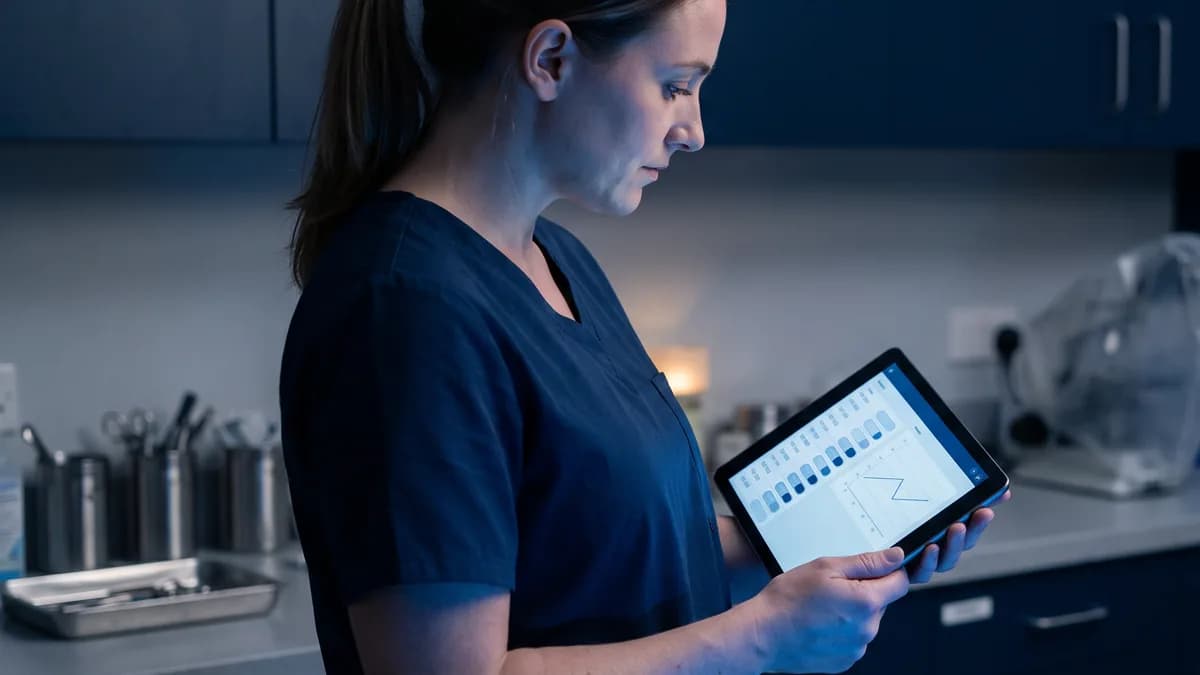
Concrete daily tasks with due times in their feed. Tasks can be delegated to a sitter, a walker or a family member. Off-plan events are logged as deviations rather than quietly lost, and the system escalates when the criteria you set are met.
What comes back to you
A structured report at follow-up: doses given and missed, observations logged, deviations, and whether the escalation criteria were reached. For the first time at scale, compliance is data rather than recollection.
Anything clinical requires your approval before it activates. The platform surfaces and organises; you decide, modify or dismiss. Nothing becomes an active protocol without that.
Three · the triage line
It advises and routes. It is a nurse-line function, and it is deterministic.
This is the single most important design fact about the platform, and it is the one most worth a sceptical read.
Code assigns urgency. A model never does.
A model is used for extraction only — turning an owner’s description into structured findings. From there the engine is deterministic logic: findings match a rule set scoped to the species, and where several rules match the engine takes the higher urgency and never a lower one. There is no downgrade path anywhere in it, and an unnameable presentation fails upward.
Why that is built that way
An urgency a model produced cannot be audited, reproduced or signed. Ask why a particular owner was told to go now and the honest answer is a sampling distribution. Ask the same of a rule table and the answer is a row, with a matching condition, an author, a source and a date. A veterinarian can put their name to a rule table.
The doctrine, unsoftened. Collect and route. Never score, never diagnose, never de-escalate. Every acute path ends at get to your vet. The product is escalate-only: it can raise the level of concern it communicates and it can never lower it. There is no path through the system by which an owner who arrived worried is talked out of going.
Routing priority goes to the pet’s practice of record and to that practice’s designated emergency hospital. Placement in that routing is not for sale, at any price, because it would compromise clinical neutrality.
Four · reactivation
Overdue preventive care becomes a visit, attributed to you.
The expected preventive baseline for that individual animal is matched against what is actually on record, and every item resolves to done, due, overdue or unknown. Anything unclear stays unknown and is flagged to confirm with you — it is never guessed.
Due and overdue items become contextual, clinically appropriate prompts routed back to the pet’s veterinarian of record. Preventive care for the animal; a revenue-positive visit for the practice, attributed and visible in your dashboard.
Guidance is jurisdiction-aware where the law is. A rabies requirement carries a real statutory citation, and a mandate without a citation is not published. Where a figure does not exist to look up, it is not invented — a visible gap is a correct answer and an invented value is a defect that surfaces in front of you.
Care you deliver through the platform
Three modes, and you choose which of them you want.
The distinction underneath all of this is a legal one, and it is worth stating precisely because it is what makes the model work. A VCPR is required to practise medicine — to diagnose, prescribe or treat. It is not required for triage. Emergency teletriage sits in an exemption that is near-universal across state practice acts and explicit in the AVMA Model Practice Act.
| Mode | What you can do | What it requires of you |
|---|---|---|
| Your own established clients | Full telemedicine — diagnose and prescribe, per your state’s rules | An existing in-person VCPR, a physical office, and a connected practice system |
| Triage only, for people who are not your clients | Advise and route. Never diagnose, never prescribe, never de-escalate | State licensure alone. No VCPR, no physical office, no integration |
| Establishing a new relationship remotely | Full telemedicine with a new client | A state that permits remote VCPR establishment, a physical office, and a connected system |
The middle row is the low-commitment one, and it is deliberate. A veterinarian who wants no part of prescribing liability can run triage alone: I am licensed in this state, and I will take a call at ten at night from someone who is not my patient. The platform enforces the boundary the same way it enforces it for the AI — every acute path ends at get to your vet.
The client is told what you can do, before they book
The system states plainly, up front, what a given veterinarian may lawfully do for that specific client — driven by where the animal is, by your licensure, and by whether a relationship already exists.
A client booking triage with a veterinarian who holds no VCPR with them sees this is triage only: no diagnosis, no prescription before they pay. It protects them from paying for something they cannot lawfully receive, and it protects you from being asked for it.
Nobody is routed somewhere they cannot reach
Emergency and twenty-four-hour hospitals lead the triage rollout, and each sets its own service radius. A client is never handed to a veterinarian hundreds of miles away only to be sent on to a different hospital they can actually drive to.
The radius starts wide and tightens as coverage fills in — at three in the morning, a competent, record-informed veterinarian is a real improvement over nothing.
Where the responsibility sits, stated plainly. Liability for staying on the right side of the triage line rests on the treating veterinarian’s licence and professional judgement. OurPack is routing infrastructure and billing rail; it is never the labour, and it does not employ veterinarians. State-by-state posture and every piece of disclaimer language attached to it are finalised with counsel before any of this reaches a client.
The boundary
What a verified veterinary account gets, and what the owner never does.
| Vet mode — clinical decision support | Owner mode — educational |
|---|---|
| Ranked differentials, with the reasoning shown | Plain-language explanation, never a differential |
| Suggested workups, and what each would rule in or out | Symptom triage that advises and routes |
| Management options with dose ranges to verify | No dosing, no treatment recommendation |
| Interaction and contraindication flags | Medication reminders and an adherence log |
| Pattern surfacing across the longitudinal record | Standing guidance framed as worth discussing with you |
| Drafted documentation for your review | Nothing drafted on a clinician’s behalf |
The platform never names an AI-suspected, clinician-unconfirmed condition to the owner. Where the reasoning layer suspects something, it is held internally and converted into better questions and better preparation for the visit — never into your pet has X. Promotion to a named condition is a clinician’s act at every step.
It has not examined the animal
- Its output is advisory. You are the treating veterinarian and hold sole professional responsibility.
- Verify every dose. Models produce fluent, confident, wrong answers.
- It reasons only from the record. A finding nobody wrote down does not exist to it.
- It is not a practice-management system. Keep your own records as your state requires.
Telemedicine is gated on the relationship
Triage and advice without diagnosis or prescription are available with no VCPR complexity. Full telemedicine — diagnosis and prescribing — requires an established VCPR, and the platform blocks first-time VCPR creation over video wherever the law requires an in-person relationship first.
Where you integrate your practice system, your own visit history is what proves the relationship — a record rather than a box you ticked. That is deliberate: it keeps certification and liability with you, and it means nobody has to take an attestation on trust.
The AI does not create a VCPR and cannot be relied on to satisfy one. All of this is in the Veterinary Professional Terms, which you accept during verification.